Artificial intelligence has received considerable media attention over the last few years. Although the technology has existed for some time, the launch of tools like ChatGPT has democratized its capabilities. Corporations are now grappling with the implications of AI usage at every level of the organization.
For example, employees may use generative AI platforms to produce written content like emails and reports or use software with AI-driven features to identify and nurture leads or gather customer information. Human resources departments may now use AI to sort through resumes, analyze interviews, and make hiring decisions.
As AI gains popularity, it’s also gaining the attention of governments and regulatory bodies. Though the U.S. doesn’t currently have any omnibus legislation on the books, the Biden administration released a statement about what the federal government has done and is doing to address widespread AI use and provide a framework for moving forward.
A number of states have passed laws regarding auditing and disclosing the use of AI software. Of course, agencies with existing regulations and laws continue to publish guidance clarifying guidelines for AI use in making consequential decisions, such as patient treatment plans, job candidate selection, or loan underwriting decisions. Companies must still adhere to all anti-discrimination, labor, and data privacy laws.
Clearly, boards need to pay attention to AI. While technology has presented opportunities for innovation, it can also harm people, organizations, and business ecosystems. For example, if it doesn’t work properly, AI technology can produce erroneous financial reports, perpetuate discrimination, or disrupt supply chains.
Boards need to be informed about all the ways their companies use AI technology, and they also need to develop an AI governance framework that protects the company and its stakeholders. How best to accomplish that goal is a topic that deserves priority discussion in boardrooms.
The Importance of AI Expertise in the Boardroom
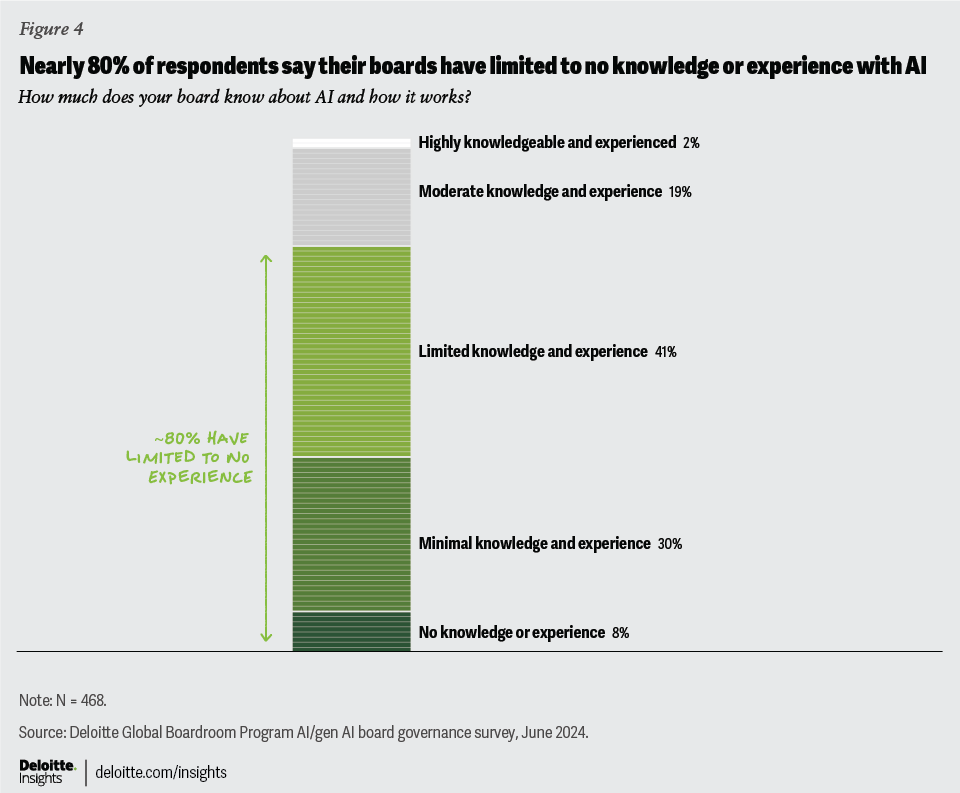
According to a recent Deloitte survey, nearly 80% of boards say that their members have limited, minimal, or no knowledge or experience with AI technology. However, board members know that it’s difficult to provide oversight for something you know very little about.
Corporate boards have a duty to ensure compliance with laws and regulations and uphold ethics regarding the use of AI. Having board members with AI expertise can go a long way toward meeting this responsibility.
Consequently, board nomination committees need to add AI knowledge and experience to their candidate selection criteria.
However, this doesn’t mean that boards have to go looking for someone with the deep technical expertise found in their chief technology officer or chief information officer.
It also doesn’t mean that the selection committee needs to pursue a single-issue director who focuses solely on the issues surrounding AI use.
Instead, it may be more valuable to find candidates with significant experience implementing and managing AI in the business environment.
Action Steps for Comprehensive AI Governance
With AI technology changing so rapidly, creating a solid framework for governance can be challenging. Here are some foundational approaches boards can take to provide adequate oversight for this evolving landscape.
Create a Structure for Oversight
In addition to putting AI on the agenda, boards might consider forming a specialized technology committee that can gather and disseminate information and updates and liaise with key technology personnel throughout the organization.
Whether the board decides to delegate tasks to a committee or not, there should be a clear delineation of which AI-related roles and responsibilities fall to the board and which fall to the management team, as this provides a clear path forward for governance.
Invite Experts to the Table
Boards should listen to a wide variety of voices when making technology-related decisions.
This includes hearing from the CTO, CIO, chief human resources officer, chief compliance officer, general counsel, and any other members of the management team whose departments may be impacted by AI use and oversight.
Additionally, it can be helpful to engage with outside experts who can provide a granular analysis of current and emerging risks and opportunities from both a technological and a business perspective.
Understand the Risk Profile and Assessment
The board should understand which AI-driven tools the company is currently using and how they fit into the business framework. Additionally, management should be able to explain to the board whether and how these tools have been audited for accuracy, safety, and bias before deployment.
In areas where AI use can heighten compliance risks, boards should weigh whether the company has the risk appetite to take on this software. Though AI use may present opportunities for growth, the board should use this comparative analysis to decide whether other approaches would be better given the risk level presented.
Understand Management Controls and Review Them Regularly
The management team should provide the board with up-to-date information about AI-related risk management and internal controls. For example, they’ll need to explain how they’ll maintain human oversight, especially in sensitive areas like financial reporting or talent acquisition. It’s also important to know how they’ll measure results so the board can properly oversee AI progress.
AI is ever-changing, so boards must review these controls regularly to ensure they’re still valid. This way, board members will have an opportunity to identify and address any emerging risks and ensure compliance with new regulations.
Consider Communication With Stakeholders
The board should decide how and when AI use will be communicated internally and externally. This is especially important given the SEC’s new disclosure requirements for cybersecurity governance, which can be greatly affected by AI use.
Keep in mind that transparent communication helps develop trust with all stakeholders, especially as some remain suspicious about AI use and data privacy.
Good AI Governance Helps Companies Maximize Growth and Minimize Risk
AI development has been fast-moving in the last few years, and it’s imperative that boards keep up. Seeking members with business-related AI expertise is foundational to the board’s ability to achieve this goal.
Additionally, boards must look to develop effective governance frameworks that involve a clear delineation of the board and management team’s roles while ensuring robust collaboration between these entities. With the right governance approach, boards can strike a balance between seizing growth opportunities and protecting the organization at every turn.